
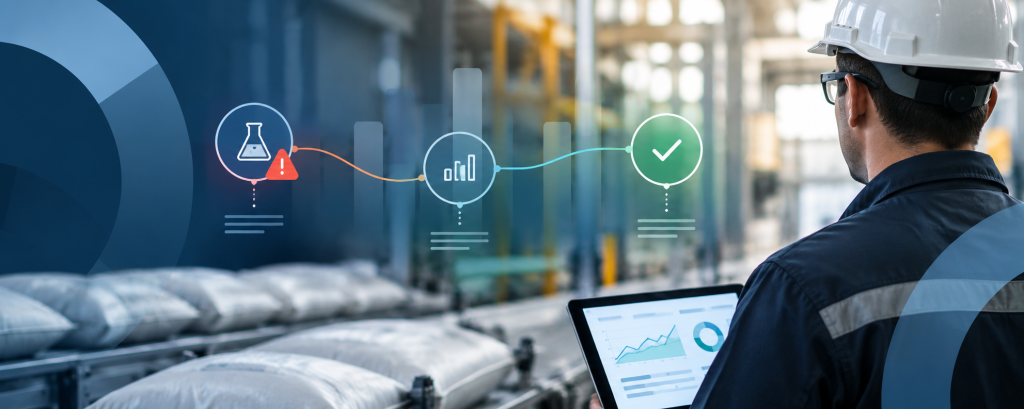
In-Line Durability Measurement: Why It Matters and What Risks It Helps Prevent
In many industrial plants, there is one question that can only be answered once the product has already been manufactured:
Does it actually meet the expected quality standards?
For years, the answer has depended on tests performed outside the production line.
A sample is collected. It is sent to the laboratory. The test is performed. And hours later, the results become available.
The challenge is clear. By the time a deviation is detected, production has already continued. And with it, the costs associated with rework, waste, or out-of-specification products have also increased.
That is why more industries are looking for a new way to ensure quality. Not after the process. During the process.
Quality Should Not Depend Solely on the Laboratory
Laboratory testing remains essential for validating product characteristics.
However, when it is the only source of information available, the ability to react is limited.
While waiting for a result, situations such as the following may occur:
- Variations in raw materials.
- Changes in process conditions.
- Equipment wear.
- Incorrect operating adjustments.
By the time the laboratory result becomes available, the deviation may have already affected a significant portion of production.
The question is:
What would happen if that information were available while the process was still running?
From Quality Control to Real-Time Quality Monitoring
Industry is evolving toward a model where information is no longer simply a historical record.
It becomes a tool for taking action while production is still underway.
This means moving from a reactive approach:
Produce → Measure → Correct
to a much more efficient approach:
Measure → Detect → Adjust → Produce Better
That shift can make a significant difference in productivity and process consistency.
Why Measure Durability During the Production Process?
In processes where product durability is a critical parameter, understanding its behavior while the production line continues to operate enables much faster decision-making.
This helps to:
Detect Deviations Early
Before they affect large production volumes.
Reduce Waste
By adjusting process parameters in a timely manner.
Minimize Rework
Preventing out-of-specification products from continuing through the production line.
Improve Process Stability
Operations no longer depend solely on post-production verification.
Increase Confidence in Product Quality
With information available virtually in real time.
More Information Means Better Decisions
One of the most important lessons in industrial automation is that measuring more variables does not necessarily guarantee better results.
What matters is measuring the variables that actually enable action.
When durability data is available during production, it becomes possible to answer questions such as:
- Is the process remaining stable?
- Is there a deterioration trend?
- Should process parameters be adjusted before continuing?
- Are we producing within the expected quality standards?
Quality then stops being a post-production validation and becomes a process control variable.
A Solution Developed from Real Plant Experience
Through multiple industrial projects, the Ingelam team identified a recurring need.
Companies needed to reduce the time between measurement and action.
That need led to the development of the In-Line Durability Measurement System, a proprietary applied-engineering solution developed by Ingelam.
Its purpose is not to replace traditional laboratory testing methods.
Its purpose is to complement the production process with information that enables timely detection of deviations and strengthens decision-making during operations.
It is a tool designed to bring quality control closer to where the process actually happens.
Quality Data Can Also Be Integrated
One of the greatest advantages of this type of solution is that information no longer remains isolated.
When integrated with the plant’s digital infrastructure, the data can feed:
- Production management systems.
- Industrial analytics platforms.
- Performance indicators.
- Historical quality records.
- Process traceability systems.
This makes it possible to build a much more comprehensive view of operations and supports continuous improvement.
Ingelam’s Vision
At Ingelam, we believe that applied engineering is about solving real operational challenges.
That is why we develop proprietary solutions that emerge directly from the needs we identify on the plant floor.
The In-Line Durability Measurement System is an example of that philosophy.
Its purpose is not to add technology simply for the sake of technology.
Its purpose is to provide timely information so that decisions can be made before problems escalate.
Because when quality can be measured during the production process, operations gain speed, stability, and confidence.
How Quickly Can Your Plant Detect a Quality Deviation?
If your operation currently relies exclusively on post-production verification or laboratory testing to understand process performance, there may be an opportunity to take action much earlier.
👉 Discover how the In-Line Durability Measurement System can help strengthen industrial quality control and reduce losses associated with process deviations.
